
Hangul block preview
Let's first look at the main principle that Hangul is a syllable block made up of consonants and vowels.

Letters, sounds, expressions, grammar, and situations follow one deliberate sequence, so each lesson prepares learners for the next.

K0 · HANGUL FOUNDATION
Vowels are met first, combined with consonants, and then expanded to reading and writing syllables and final consonants.
Let's first look at the main principle that Hangul is a syllable block made up of consonants and vowels.
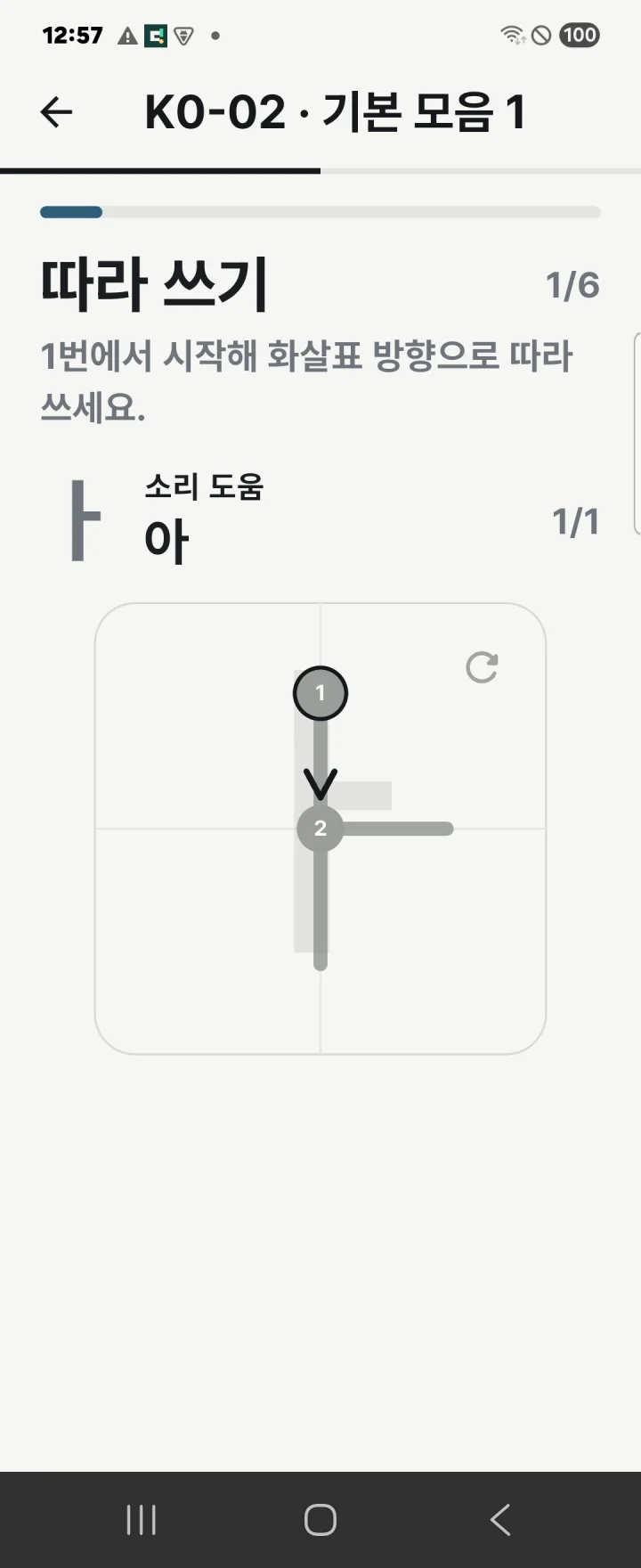
Connect shapes and sounds, observe the stroke order, and then trace and copy them.
Learn the sounds in syllables that meet vowels so that you do not misunderstand the name of a consonant alone as a phonetic value.
Understand the representative final consonant system and decipher new syllables using the letters you have already learned.
K1 · BEGINNER KOREAN 1
Rather than memorizing just one representative conversation, you use the same functions again in multiple example sentences, questions, and new situations.
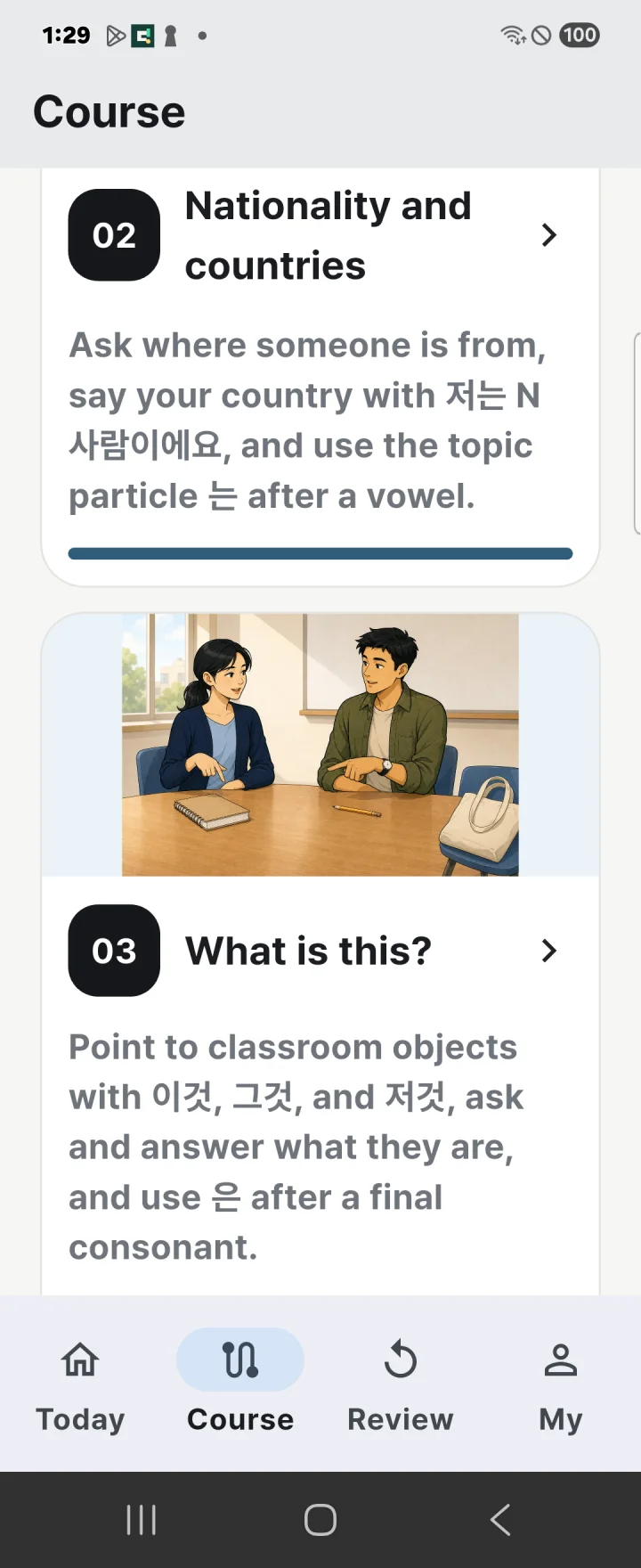
Students learn basic sentence structures by asking and answering questions about greetings, names, nationalities, and classroom objects.
It expands the investigation and expression of existence by referring to occupations, roles, families, and locations.
It refers to schedules, times, and basic movements, and increases the length of real-life utterances.
Be specific about what you do and synthesize the expressions you have learned in different situations.
WHAT A LESSON CONTAINS
A representative conversation of the situation is the starting point, with comprehensible input and ample variation practice filling in around it.
Experience key features first in a context where it's clear who's talking where and why.
It provides ample examples of the same grammar and expressions meeting different people, objects, and places.
Selected by the server to ensure that wording variations of the same base item are not repeated in one session.
Listen to the model's utterance and use your own name and choices to change the learned functions into your own sentences.
CONTINUE EXPLORING